The Night It Rained Stars on America
In November 1833 tens of thousands of meteors an hour fell over North America, and every one traced back to the same spot in Leo: the clue that led, 33 years later, to comet Tempel-Tuttle.
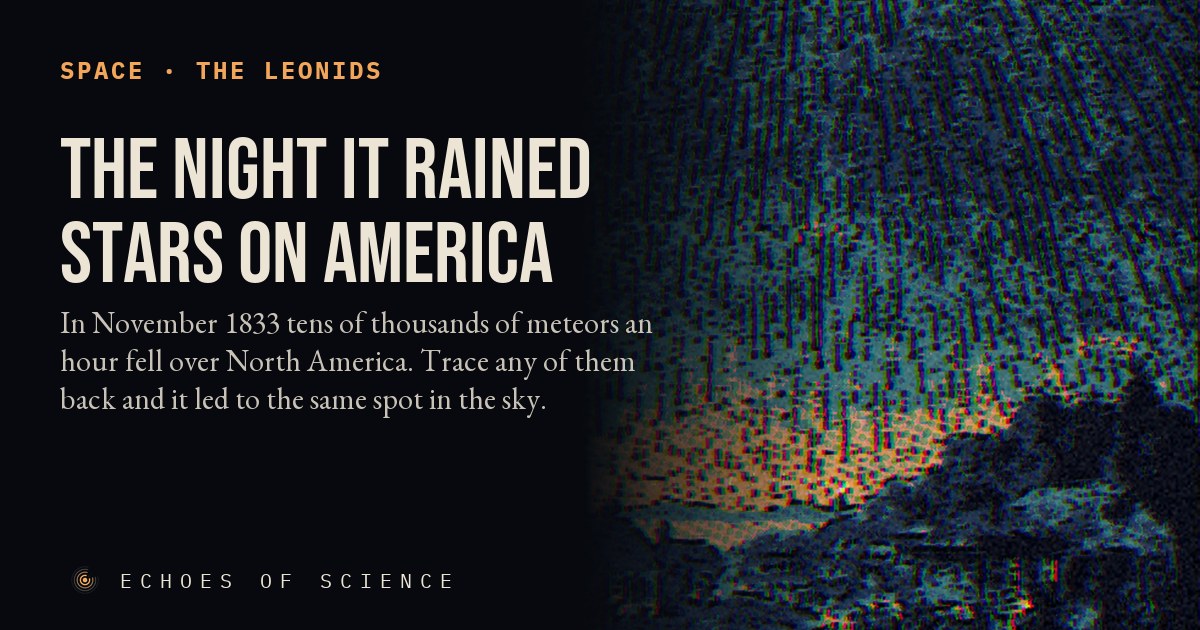
Every one of them seemed to come from the same place. In the small hours of 13 November 1833, people across eastern North America stepped outside into a sky full of falling light. Meteors streaked down in every direction, so many that observers gave up counting, yet those who watched carefully noticed something odd: trace any streak backwards and it led to one small patch of sky.
That detail turned a night of terror and wonder into one of the great clues in astronomy. It took another 33 years, and a successful prediction, to follow it to the end.
The night the stars fell
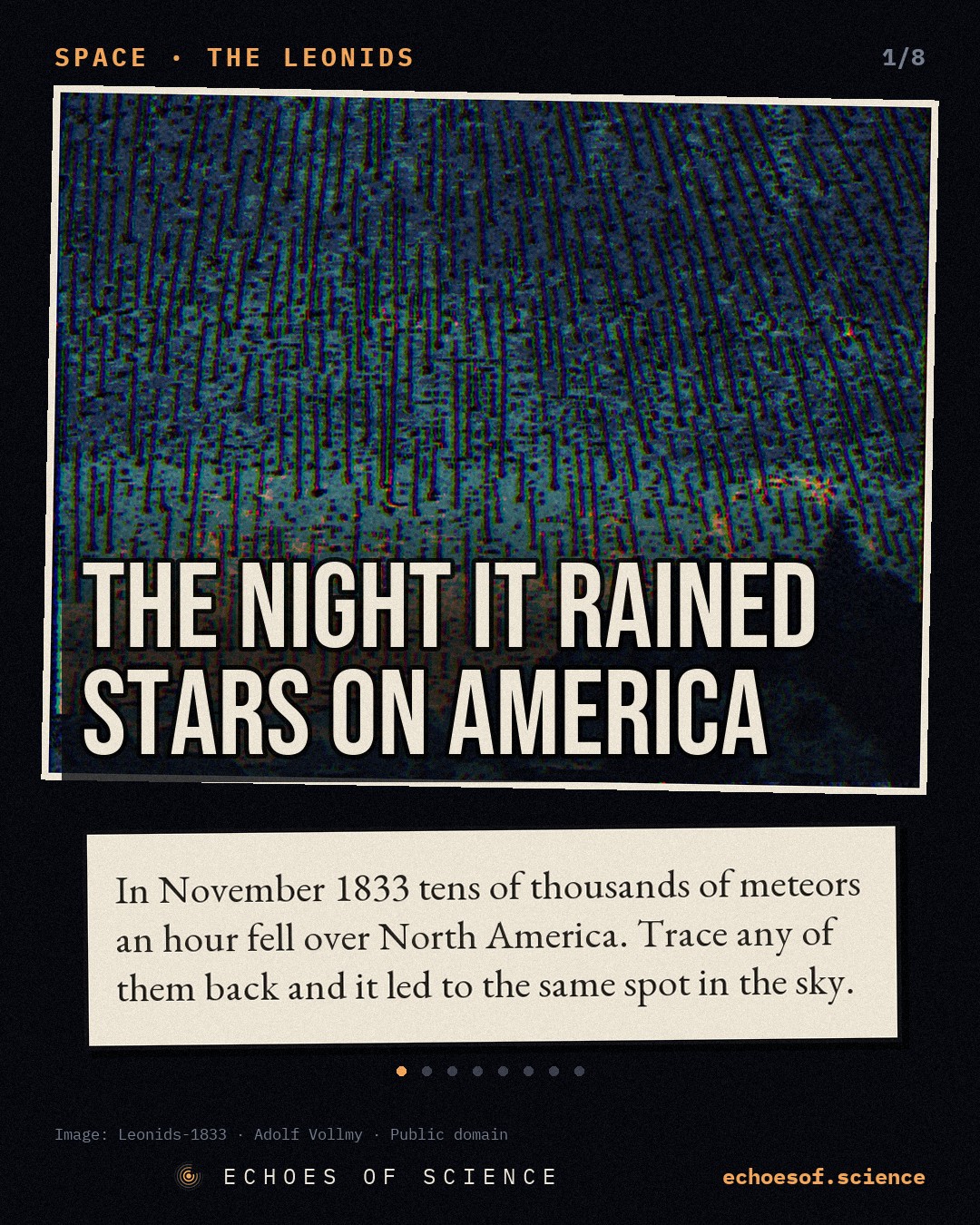
The display began around nine in the evening, peaked at about four in the morning and ran until sunrise. Modern estimates of the rate range from about 50,000 to 150,000 meteors an hour (Smithsonian Magazine). The Boston Evening Transcript reported that "There was a war of shooting stars in the northwest." Some people believed the world was ending. The night entered folklore, and a century later it gave its name to a jazz standard, "Stars Fell on Alabama".
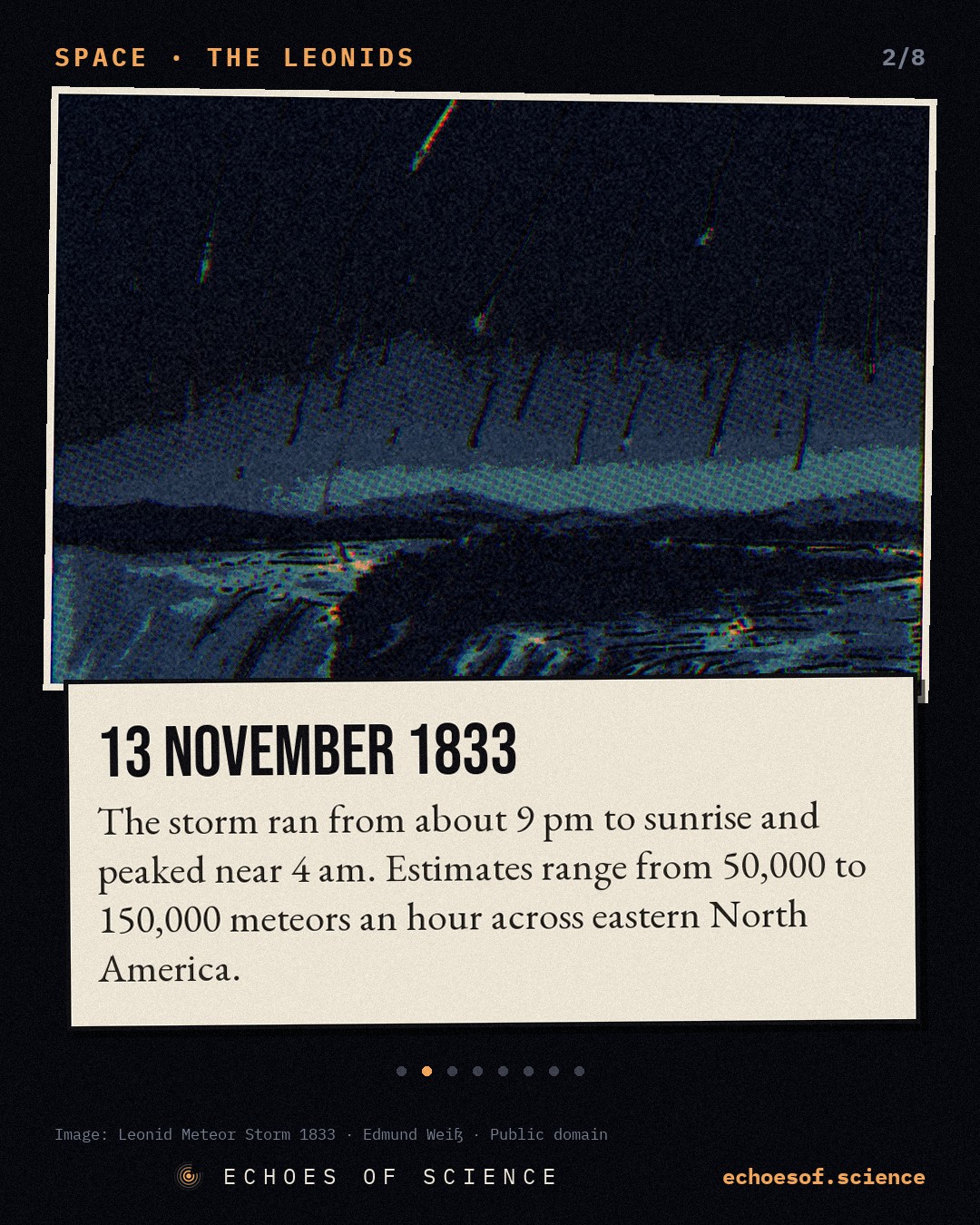
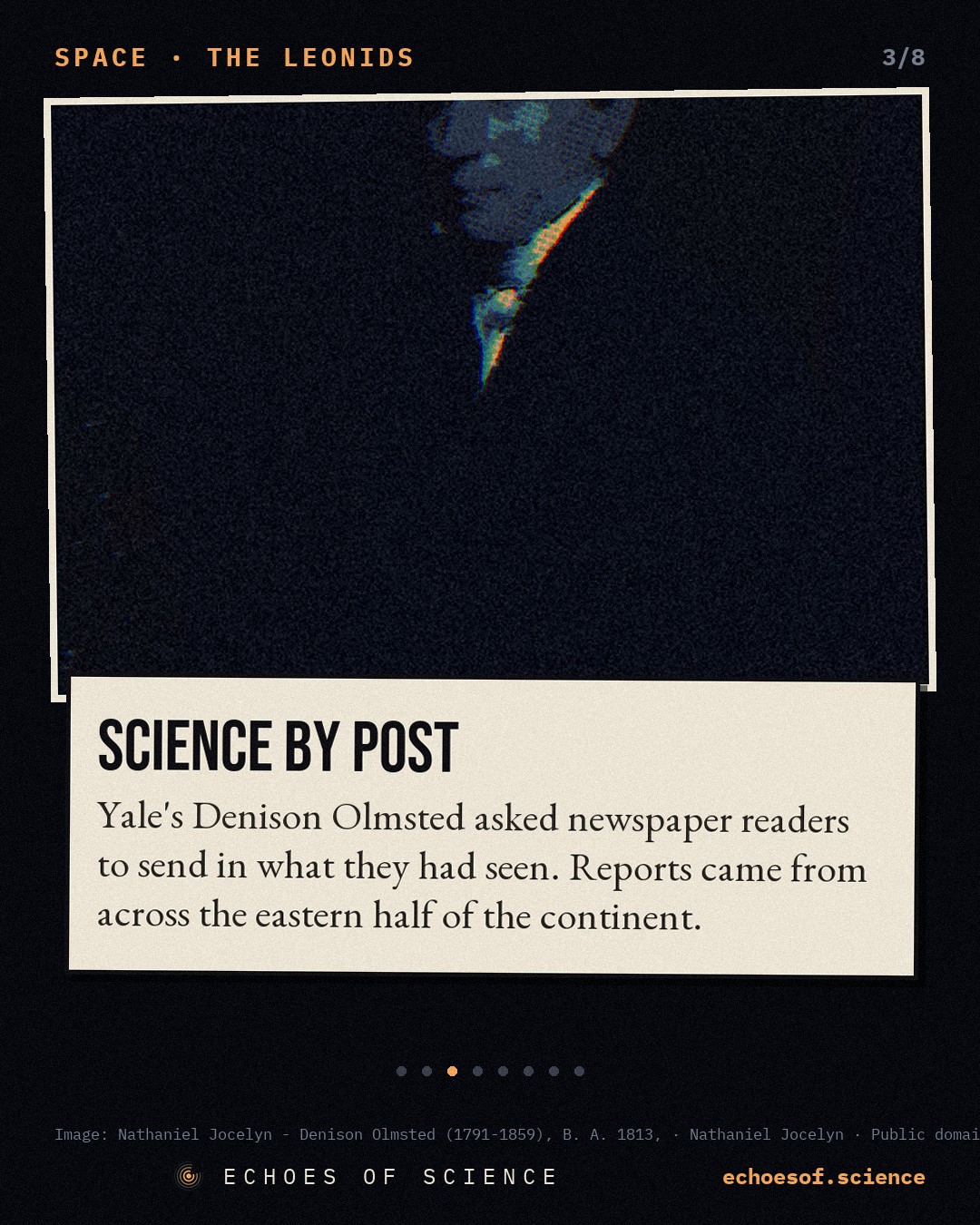
In New Haven, Connecticut, a neighbour woke Denison Olmsted, professor at Yale College, to see it. Olmsted did something unusual for 1833: he wrote to the local newspaper describing what he had seen and asked readers to send their own observations. Other papers reprinted his appeal, and reports arrived from across the eastern half of North America (American Meteor Society). It was, in effect, one of the first crowdsourced science projects.
A point that moved with the stars
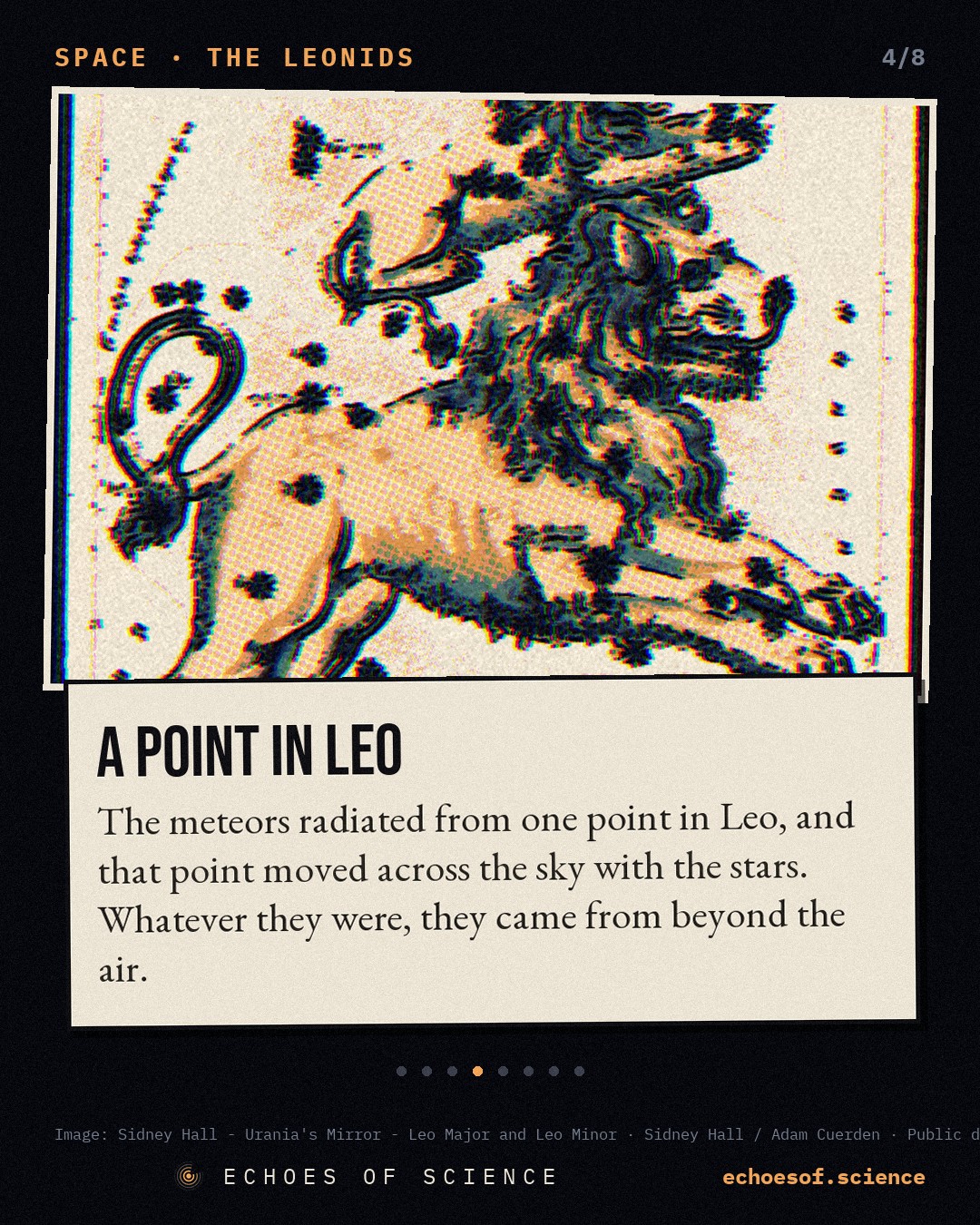
Sorting through the letters, Olmsted confirmed what the sharpest observers had noticed. The meteors radiated from a single point in the constellation Leo, and that point did not stay fixed over the horizon as the night went on. It moved across the sky with the stars (Linda Hall Library). Weather does not do that. Whatever the meteors were, they came from beyond the atmosphere, out among the stars and planets. Olmsted suggested they came from a cloud of particles in space that Earth had run into, and published his analysis in the American Journal of Science and Arts.
He did not have the whole answer. But by setting aside claims that the meteors were caused by electricity or the weather, and by following the radiant, he founded the scientific study of meteor showers.
A 33-year rhythm
The next clue lay in old records. On the night of 11-12 November 1799, the explorers Alexander von Humboldt and Aimé Bonpland had watched a similar storm from Cumaná, in what is now Venezuela, describing thousands of fireballs and shooting stars over four hours (History of the Leonid Meteors). 1799 to 1833 is 34 years.
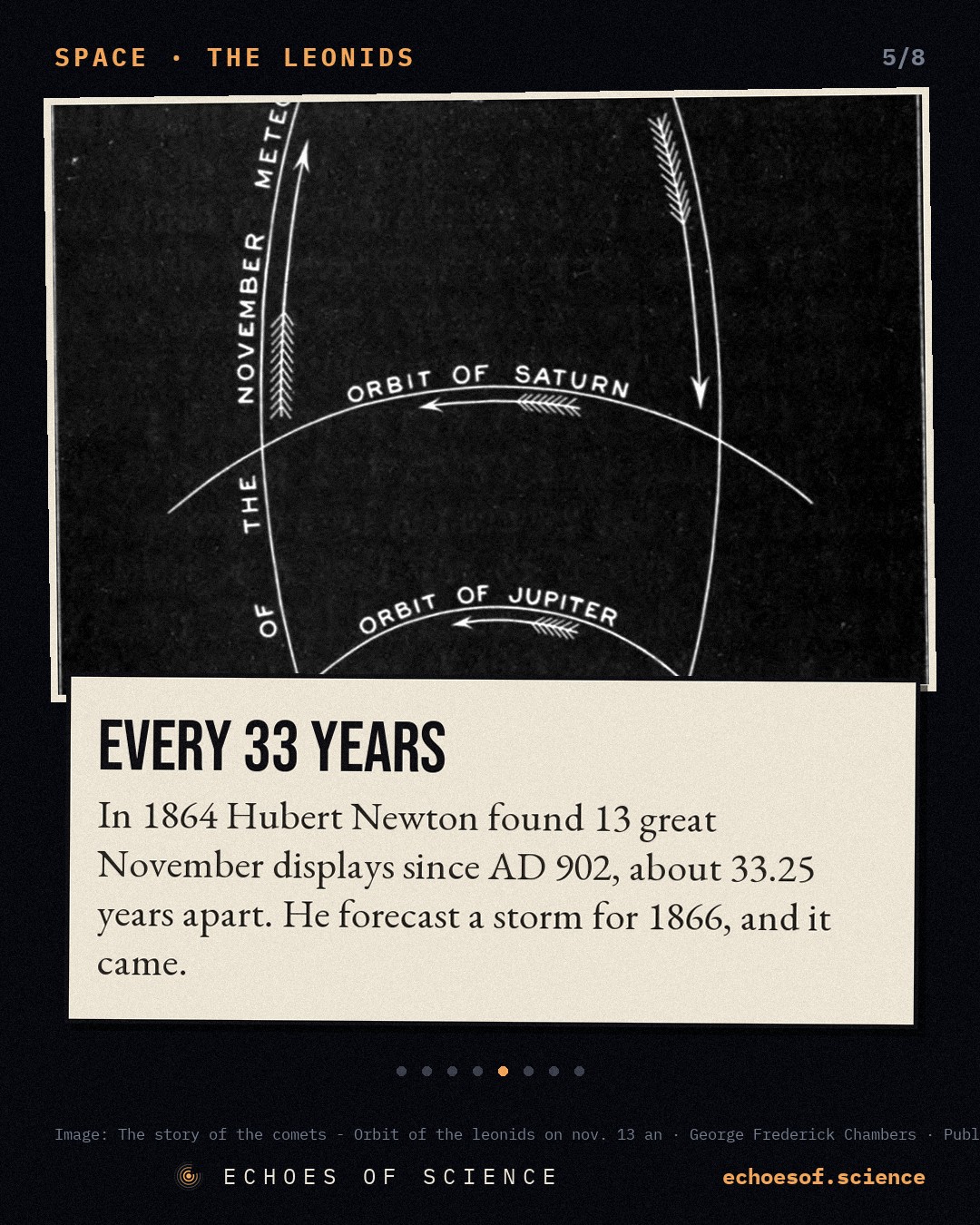
In 1864 Hubert Anson Newton, a mathematician at Yale, searched every record he could find and identified thirteen great November displays since the year 902, recurring on a cycle of about 33.25 years (Encyclopedia.com). He predicted the shower would storm again in 1866. Observers in America and Britain kept watch, and in November 1866 the Leonids returned in strength, seen above all from Europe.
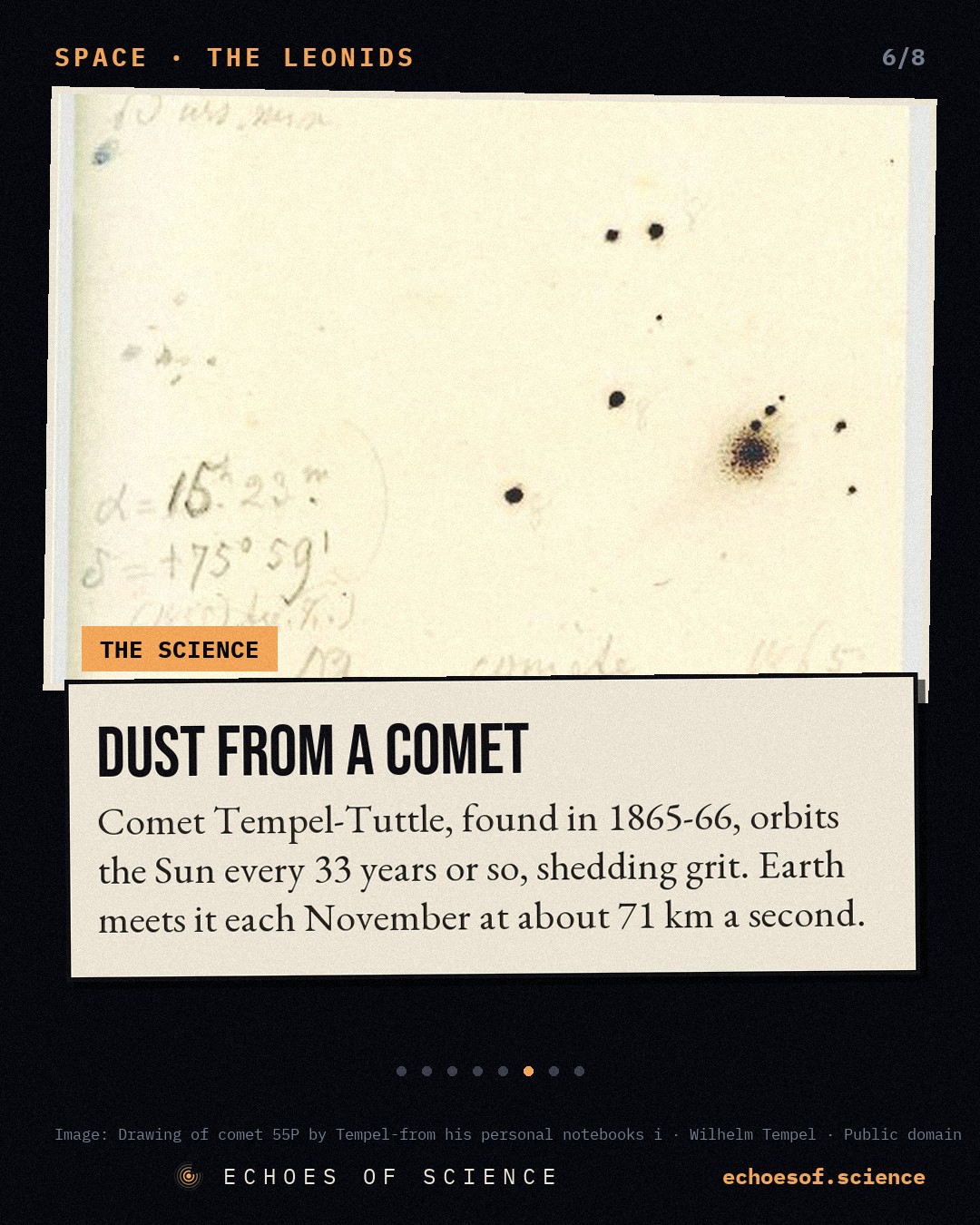
Meanwhile, a faint comet had been found twice: by Ernst Tempel in 1865 and by Horace Tuttle in 1866 (NASA). When astronomers worked out its orbit, it matched the orbit of the Leonid meteors almost exactly. Comet Tempel-Tuttle goes round the Sun about once every 33 years. The rhythm of the storms was the rhythm of the comet.
The science: dust, speed and perspective
A comet is a lump of ice and rock, Tempel-Tuttle's nucleus about 3.6 kilometres across. Each time it swings close to the Sun it sheds dust and grit, which spread along its orbit. Every November Earth crosses that orbit, and the grains hit our atmosphere at about 71 kilometres a second, among the fastest of any meteor shower (NASA). They burn up high above the ground.
The radiant is an effect of perspective. The grains travel in parallel, all moving the same way. Seen from the ground, parallel lines seem to spread out from a single distant point, just as railway tracks seem to meet at the horizon. That point happens to lie in Leo, which is why the shower is called the Leonids.
Storms happen when Earth passes through a dense, fresh trail of dust shed shortly before, which is why they cluster in the years around the comet's return. Even then they are not guaranteed, because gravitational perturbation by the planets nudges the trails. A great storm forecast for 1899 largely failed to appear. In 1966, though, observer Dennis Milon at Kitt Peak in Arizona estimated about 150,000 meteors an hour for some 20 minutes. The last Leonid storm came in 2002.
How do we know?
Our picture of 1833 rests on hundreds of eyewitness letters gathered by Olmsted, on newspapers of the time and on later analysis. The hourly rates are estimates reconstructed from untrained observers, which is why they vary so widely. The modern link between the shower and Tempel-Tuttle rests on orbital calculations and on the many returns of the shower observed since.
Why it matters today
The Leonids return every year. In 2026 the shower peaks around 17 November, with perhaps 10-15 meteors an hour from a dark site, and the Moon sets around midnight, leaving the best pre-dawn hours dark (Royal Museums Greenwich). Tempel-Tuttle itself is due back near the Sun in 2031. No one can promise another 1833, but anyone who looks up in mid-November is watching the same dust that sent people running into the streets nearly two centuries ago, and that taught science where shooting stars come from.
The science in this story
Key facts
- On 12-13 November 1833 a Leonid meteor storm lit up eastern North America from about 9 pm to sunrise, peaking near 4 am; estimates range from 50,000 to 150,000 meteors an hour source ↗
- Yale professor Denison Olmsted asked newspaper readers to send in observations; reports came from across the eastern half of North America source ↗
- Olmsted found the meteors radiated from a point in Leo that moved with the stars, showing they came from beyond the atmosphere source ↗
- Olmsted suggested the meteors came from a cloud of particles in space and published his analysis in the American Journal of Science and Arts source ↗
- Humboldt and Bonpland saw a Leonid storm from Cumaná, Venezuela, on the night of 11-12 November 1799 source ↗
- In 1864 Hubert Anson Newton found 13 great November displays since AD 902, on a cycle of about 33.25 years, and predicted a storm for 1866, which came source ↗
- Comet Tempel-Tuttle was found by Ernst Tempel in 1865 and Horace Tuttle in 1866; it orbits the Sun about every 33 years and is the Leonids' parent; next perihelion 2031 source ↗
- Leonids hit the atmosphere at about 71 km/s; a storm means at least 1,000 meteors an hour; the last Leonid storm was in 2002 source ↗
- In 1966 Dennis Milon at Kitt Peak estimated about 150,000 meteors an hour for some 20 minutes source ↗
- In 2026 the Leonids peak around 17 November at about 10-15 an hour, with the Moon setting before midnight source ↗
In pictures
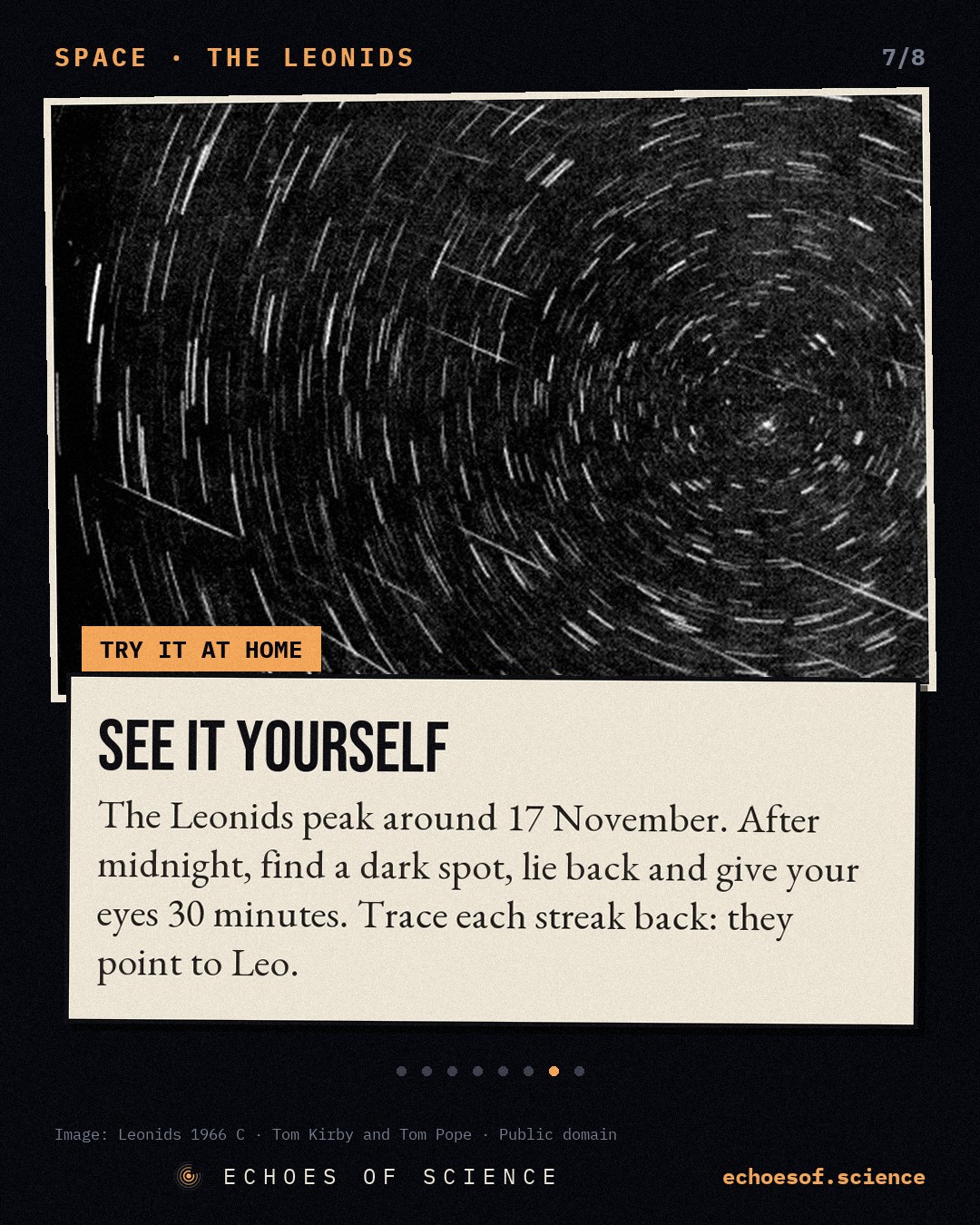

Watch the Leonids around 17 November after midnight from a dark site; give your eyes 30 minutes and trace each streak back to Leo.
Loading the quiz…
Where every picture, clip and sound in this story comes from
Keep scrolling: more true stories ↓
New mini-documentaries every week and a true story every day. Pick where you like to watch:
▶ Subscribe on YouTube Telegram TikTok Instagram Bluesky Threads ✉ Weekly email