Why Is Mars So Small? It Stopped Growing at Birth
Mars has about a tenth of the Earth's mass, and the chemistry of Martian meteorites says it reached half its size within about two million years of the solar system's birth. Then it stopped. Why did the planet next door stay so small, and what did being small cost it: its magnetic field, its air, its rivers and lakes, and perhaps its chance at life?
 The documentary is coming soon to YouTube · subscribe to get it
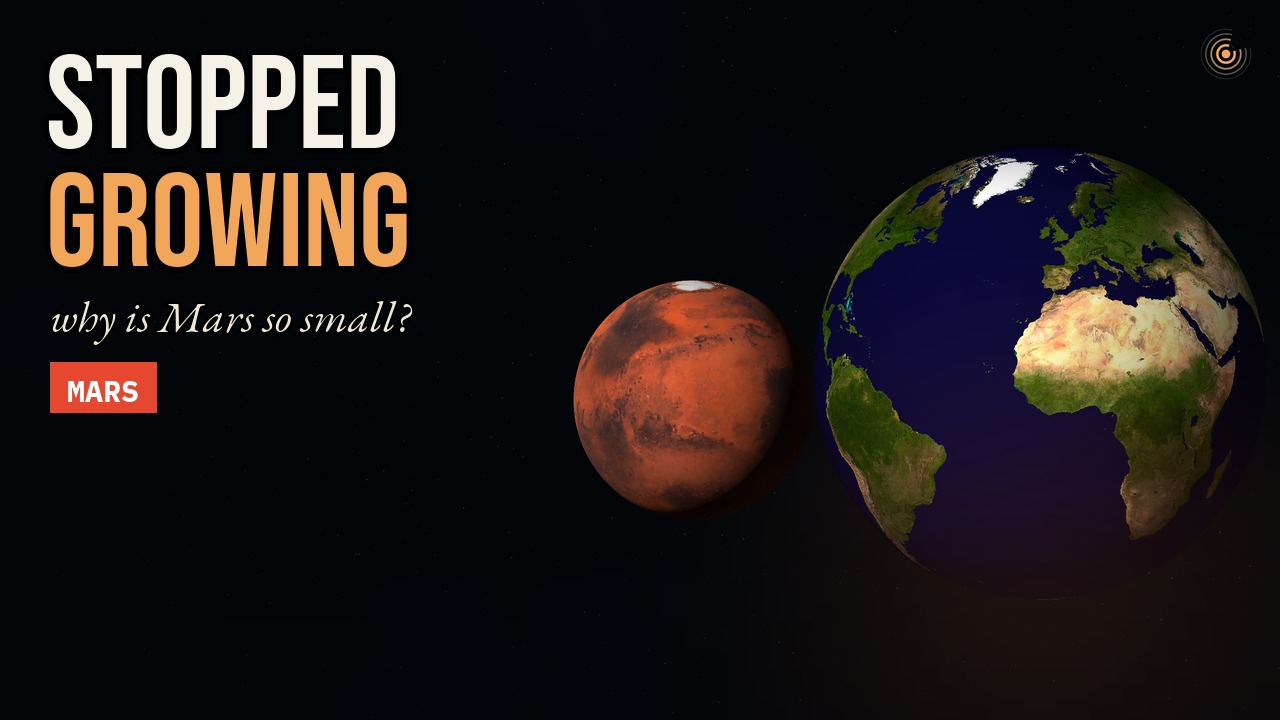
This is Mars. A planet that stopped growing almost as soon as it was born.
It has about a tenth of the Earth's mass.
The chemistry of Martian rocks says it reached half its size in about 2 million years, and was probably finished within a few million more. The Earth kept growing for tens of millions of years.
So why did the planet next door stay so small? The answer may lead all the way to Jupiter. And being small may be why Mars lost its rivers, its lakes, and perhaps its chance at life.
A World of Surprises
To see why that size matters, go back to the first time we saw Mars up close. On the night of 14 July 1965, NASA's Mariner 4 flew past, and took the first close-up pictures of another planet.
At the Jet Propulsion Laboratory, a machine printed the first picture's data as rows of numbers on strips of paper. Engineers were too eager to wait for the computers. So they coloured the numbers in by hand, like a painting by numbers.
Over the next weeks, 22 pictures came back. They showed craters. A cratered, Moon-like world, with air at the surface only about 1% as thick as ours.
Six years later, in November 1971, Mariner 9 became the first spacecraft to orbit another planet. It arrived in the middle of a planet-wide dust storm, and had to wait for the dust to settle.
Out of the dust rose volcanoes. The largest, Olympus Mons, is about 600 km across. Its summit stands about 24 km above the plains around it.
There was a canyon system more than 3,000 km long, and about 8 km deep on average. Today it carries the spacecraft's name: Valles Marineris.
And Mariner nine saw something nobody expected on a dry, frozen world: winding channels, like dried-up riverbeds.
On 20 July 1976, Viking 1 landed, and took the first photograph ever made on the surface of Mars. Rocks, sand and dust, as far as the camera could see.
Giant volcanoes, dry rivers, air too thin to breathe. Mars was a puzzle. And one of the biggest pieces was hiding in plain sight: its size.
The Small Planet Problem
Mars is just over half as wide as the Earth, and its gravity is 38% of ours. Stand on it, and you would weigh less than two-fifths of what you weigh here.
Its air is 95% carbon dioxide. At the surface, it presses down with less than 1% of the pressure we feel at sea level.
Mars orbits about 1.5 times farther from the Sun than we do. Its year lasts 687 Earth days. Its day is almost the same as ours: about 24 hours and 40 minutes.
For planetary scientists, that small size is a real headache. When they simulate how the rocky planets were built, the computers keep making a Mars that is far too big. Often as big as the Earth.
The puzzle even has a name: the small Mars problem. To solve it, you have to go back to the very beginning.
Born in a Hurry
About 4.5 billion years ago, the young Sun was surrounded by a flat, spinning disc of gas and dust.
We can see discs like that today, around other young stars. This one, around a star called HL Tauri, was imaged in 2014 by the ALMA telescope in Chile. Its dark rings may be gaps swept by forming planets.
In our own disc, dust stuck together into pebbles, and pebbles into bodies kilometres across, called planetesimals. The biggest pulled in the rest, and grew into planetary embryos: worlds the size of the Moon, or of Mars.
To finish a planet like the Earth, many of those embryos had to collide and merge. That took tens of millions of years.
So how do you date the birth of a planet? With a clock built into its rocks. A rare form of the metal hafnium decays into tungsten, with a half-life of about 9 million years.
Hafnium stays in rock. Tungsten is drawn to iron, and sinks with it into a planet's core. So the rocky mantle keeps a record, written in tungsten, of how early the core formed.
The clock is read in meteorites from Mars. But how do we know a meteorite came from Mars? Some carry tiny pockets of trapped gas. In the 1980s, scientists found that the gas matched the Martian air measured by the Viking landers.
In 2011, Nicolas Dauphas and Ali Pourmand compared more than 30 primitive meteorites with 20 meteorites from Mars. Their result: Mars reached half its present size within about 2 million years of the solar system's birth.
It was probably finished within 2 to 4 million years. Mars, they concluded, is a planetary embryo that never grew into a full planet: a leftover building block, still circling the Sun.
Growing that fast had a consequence. The young disc still held a short-lived radioactive form of aluminium, which gives off heat as it decays. A Mars built in a few million years could have trapped enough of it to melt.
Another rock from Mars supports this early start. A meteorite found in north-west Africa, nicknamed Black Beauty, holds tiny zircon crystals about 4.5 billion years old: the oldest Martian material ever dated directly.
In 2018, a team in Copenhagen found evidence that Mars already had a solid crust about 20 million years after the solar system was born.
So Mars grew fast. Then the building material around it ran out. The question is: where did it go?
Jupiter's Detour
That same year, a team led by Kevin Walsh proposed a bold answer in the journal Nature. They called it the Grand Tack.
Jupiter, they suggested, formed at about 3.5 times the Earth's distance from the Sun. Then the gas of the disc dragged it inward, to about 1.5 times our distance. Roughly where Mars is today.
Like a wrecking ball, it scattered the rocky material out there. Then Saturn, also drifting inward, caught up with it. Between them, the two giants cleared away the gas, and their motion reversed.
Jupiter sailed back out, to just over 5 times our distance, where it is today. Like a sailing boat changing course: a tack.
Inside the Earth's orbit, plenty of rock was left to build the Earth and Venus. Beyond it, very little. Mars was left with slim pickings.
The model may also explain a strange mix in the asteroid belt, where rocky asteroids and icy ones sit side by side.
But there is another explanation. In 2018, Matt Clement and his colleagues suggested that the giant planets went through a violent shake-up very early, while the rocky planets were still forming.
In their simulations, that shake-up stirred the region around Mars so strongly that it stopped growing. Without it, Mars often came out about as heavy as the Earth: roughly 9 times too big.
Two different stories, one ending: something stopped Mars from growing, and the giant planets are the prime suspects. Which story is right is still open. But either way, being small came with a price.
A small planet cools faster. It has less heat inside for every square metre of surface. A cup of tea goes cold long before a full teapot does.
That matters, because a planet's magnetic field comes from its core. Molten iron, churning as the core loses heat, works like a dynamo.
In 1999, NASA's Mars Global Surveyor found bands of magnetism frozen into the old rocks of the southern highlands. Mars once had a global magnetic field.
But the giant impact basins, about 3.9 billion years old, carry almost none. So the dynamo seems to have died early. Some later studies argue it lasted a few hundred million years longer.
Then a lander listened to the inside of Mars. NASA's InSight touched down in November 2018, set a seismometer on the ground, and recorded more than 1,300 marsquakes.
In 2023, two teams found evidence of a layer of molten rock wrapped around the core. The core itself is smaller than first thought: about 1,650 km in radius, roughly half the radius of the planet.
Without a global magnetic field, the upper air of Mars meets the solar wind, the stream of particles from the Sun, head on. And its weak gravity holds that air less tightly than the Earth does.
In 2014, NASA's MAVEN spacecraft arrived to measure the loss. Its team compared two forms of argon, and found that about two-thirds of the argon Mars ever had in its air has been lost to space.
They concluded that most of the planet's carbon dioxide probably went the same way.
MAVEN watched for 11 years. On 6 December 2025, it fell silent behind Mars. In June 2026, NASA declared it lost.
The watch goes on. The United Arab Emirates' Hope probe, in orbit since February 2021, studies the weather of Mars and its upper air, where the planet is still leaking into space. China's Tianwen-1 and India's Mangalyaan have orbited Mars too.
Lose your air, and you lose your water. Under air that thin, liquid water cannot last long on the surface. But billions of years ago, it clearly did.
The Wet Years
On 18 February 2021, NASA's Perseverance rover landed in Jezero crater. From orbit, the crater shows a fan of sediment, where a river once flowed in.
Up close, the rover's cameras confirmed it: the tilted layers of an ancient river delta. About 3.7 billion years ago, Jezero held a lake.
Higher up, the rover found boulders about a metre across, carried in by violent floods.
Since 2012, the Curiosity rover has been climbing Mount Sharp, inside Gale crater, another ancient lake bed.
In 2025, its team reported a mineral called siderite in three drill samples. Carbon from the old atmosphere, locked into rock.
It accounts for only part of the missing carbon dioxide. But it shows that the air of Mars once held far more, and that some of it was turned into stone.
On 15 May 2021, China's rover Zhurong landed on the plains of Utopia Planitia. China became the second country, after the United States, to drive a rover on Mars.
Zhurong carried a ground-penetrating radar. Beneath its tracks, it found buried layers that slope gently downwards, like the sand of a beach running into the sea.
In 2025, scientists from China and the United States argued that these are the shores of an ancient northern ocean. It is new evidence for an idea that is decades old, and still debated.
Rivers, lakes, perhaps an ocean. Mars was once a world with water. And on Earth, almost wherever there is liquid water, we find life. So: was there ever life on Mars?
Leopard Spots
In July 2024, in an old river valley at the edge of Jezero, Perseverance came across a reddish rock. The team nicknamed it Cheyava Falls.
It was covered in small spots, pale in the middle with dark rims, like the spots of a leopard. The rims held two minerals: vivianite, an iron phosphate, and greigite, an iron sulphide.
On Earth, minerals like these often form in reactions driven by microbes, feeding on organic matter in mud. In September 2025, the team published its analysis in the journal Nature.
NASA called it a potential biosignature: a sign that might have a biological origin. Not proof. Chemistry without life might have made the same spots, and the scientists say they cannot rule that out.
To be sure, the rock has to be studied in laboratories on the Earth. Perseverance drilled a core from it, called Sapphire Canyon, and sealed it in a tube. By July 2025, the rover had filled 33 tubes.
But the mission to bring them home, NASA's Mars Sample Return, grew too expensive. In January 2026, the United States Congress stopped funding it. It is formally cancelled.
China now plans its own sample return mission, Tianwen-3. It is to launch in 2028, collect its own rocks, and bring them to the Earth around 2031.
Epilogue
So, how was Mars born? Fast. In just a few million years, it grew from dust into a world half as wide as the Earth.
And then it stopped, probably because the giant planets stirred up or swept away the material it needed. Exactly how is still debated.
Being small shaped everything that came after. Its core cooled, its magnetic field faded, its air leaked into space, and its rivers and lakes dried up.
And somewhere in those dry lake beds, or in a sealed tube inside a rover, there may be an answer to one of the oldest questions we have. Was the Earth ever the only living world around the Sun?
Mars now takes its place on our map. Next week: Jupiter. Probably the first planet to form, and perhaps the reason Mars is so small.
On our website, try it yourself: grow a planet before Jupiter scatters your building blocks.
The science in this story
Key facts
- Mars has 0.107 of Earth's mass and 0.532 of its radius; surface gravity 3.73 m/s² (0.38) and mean surface pressure about 6.4 mbar. source ↗
- Hafnium-tungsten dating of 20 Martian meteorites shows Mars reached half its present size within about 2 million years and formed in 2-4 million years: a planetary embryo (Dauphas & Pourmand, Nature 2011). source ↗
- In the Grand Tack model Jupiter migrated in to about 1.5 AU and back out to 5.2 AU, leaving little material for Mars (Walsh et al., Nature 2011). source ↗
- MAVEN's argon isotopes show about 65% of the argon ever in Mars's atmosphere was lost to space (Science, 2017). source ↗
- Perseverance's Cheyava Falls rock (July 2024) holds a potential biosignature (Nature, Sept 2025); NASA's Mars Sample Return was formally cancelled in January 2026. source ↗
Loading the quiz…
Sources
- NASA NSSDC Mars fact sheet · NASA: Mariner 4 at 55 · NASA/JPL photojournal (Mariner 4, Mariner 9, Viking 1) · ESO/ALMA: HL Tauri (2014)
- Dauphas & Pourmand, Nature 2011 · Bouvier et al., Nature 2018 (NWA 7034) · Bogard & Johnson, Science 1983 · Walsh et al., Nature 2011 · Clement et al., Icarus 2018
- Acuña et al., Science 1999 (MGS) · Mittelholz et al., Sci. Adv. 2020 · Stähler et al., Science 2021 · Samuel et al.; Khan et al., Nature 2023 · Jakosky et al., Science 2017 (MAVEN)
- Mangold et al., Science 2021 (Jezero) · Tutolo et al., Science 2025 · Liu et al., PNAS 2025 (Zhurong) · Hurowitz et al., Nature 2025 · NASA, ESA, MBRSC, CNSA, ISRO mission pages
Where every picture, clip and sound in this story comes from
Keep scrolling: more true stories ↓
New mini-documentaries every week and a true story every day. Pick where you like to watch:
▶ Subscribe on YouTube Telegram TikTok Instagram Bluesky Threads ✉ Weekly email
Everything here is free and stays free. If you would like to help us make more: 🪐 Shop: calendars, posters, mugs & books