How to Catch a Rocket Falling From Orbit
On 14 November 2026 a launch tower in Texas caught a rocket stage that had just fallen out of orbit. Catching things from space is older, and harder, than it looks.
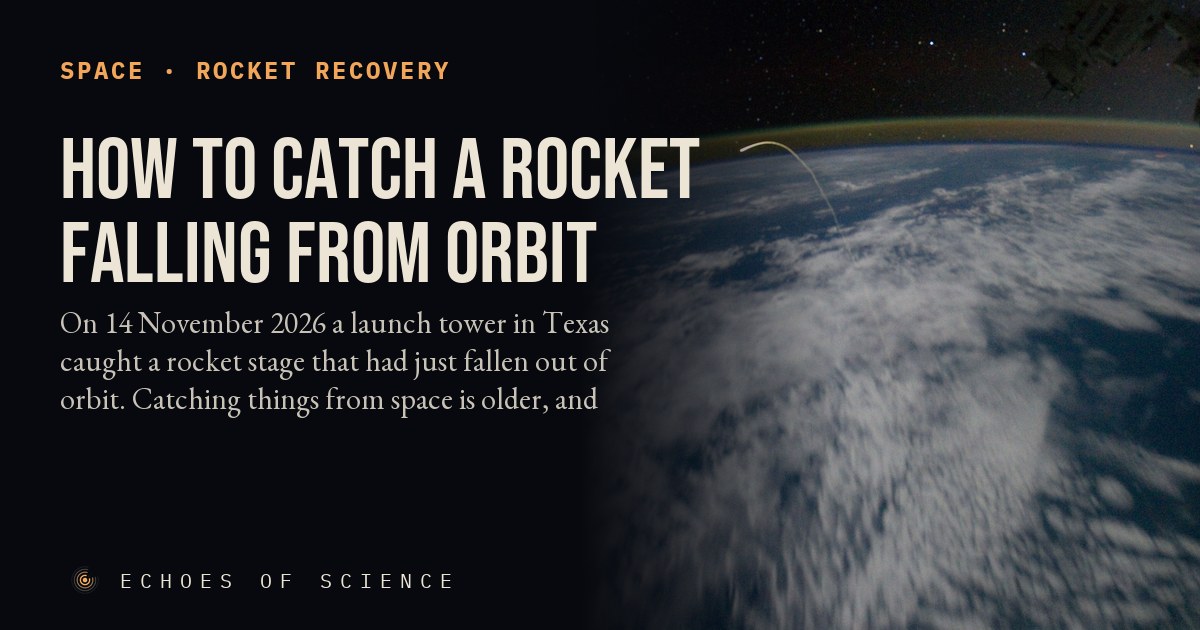
At 21:20 GMT on 14 November 2026, a stainless-steel rocket stage dropped out of a Texas sky, lit its engines, and stopped between two mechanical arms on a launch tower. It had left the same spot about 22.5 hours earlier and spent the night circling the planet. SpaceX's commentator Dan Huot summed up the moment on the webcast: "We caught a Starship, and now everything changes."
It was the first time anyone had caught the upper stage of a rocket after a trip to orbit. To see why that took so long, it helps to look at what "coming home" from orbit actually asks of a machine, and at the strange history of catching things that fall from space.
Flight 15
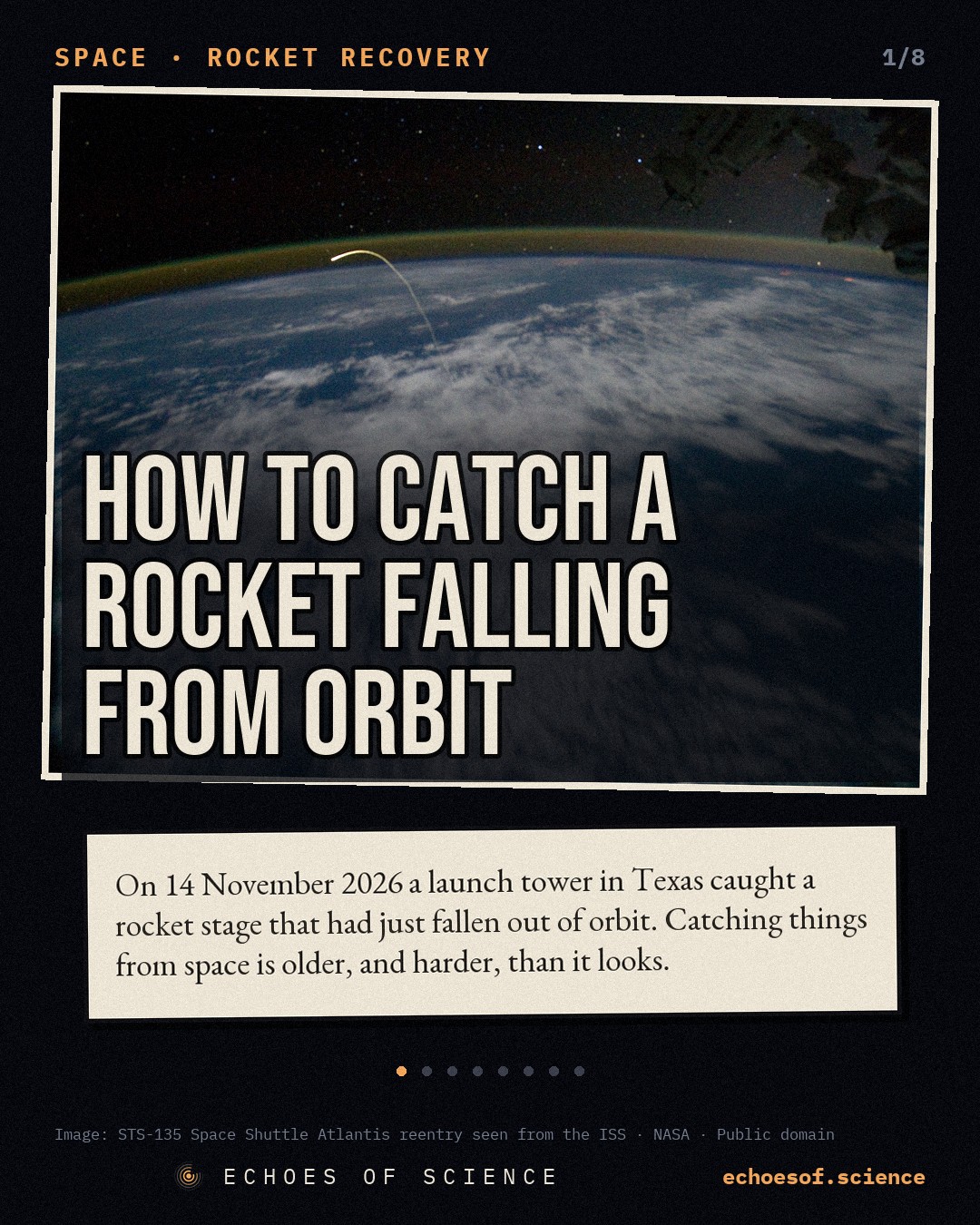
Starship's fifteenth test flight lifted off from Starbase in South Texas at 22:47 GMT on 13 November 2026, according to Space.com. The plan was ambitious: catch both stages. The giant Super Heavy booster was meant to fly back to the tower minutes after launch, and the upper stage, Ship 42, was to return the next day.
Only half of that happened. During its descent the booster called off its catch and made a controlled splashdown in the Gulf of Mexico. Commentators linked the decision to a low-fuel alarm after its boostback burn ended early; SpaceX said it was still investigating (Universe Today). Boosters had already been caught three times before, starting with Flight 5 on 13 October 2024.
Ship 42 went on to orbit at roughly 275 km, released 26 Starlink V3 satellites, and let three of them photograph its heat-shield tiles so engineers could decide whether it was safe to bring home. It was. The next afternoon the ship fired its engines to leave orbit, re-entered the atmosphere, and was caught by the tower.
How do you stop something moving at 8 km/s?
An orbiting spacecraft is not floating; it is falling. As Newton's famous cannonball thought experiment shows, something fired sideways fast enough, about 7.9 km/s near the ground, falls towards the Earth but keeps missing it (University of Nevada, Las Vegas). At Ship 42's altitude the speed is a little lower, about 7.7 km/s, or roughly 28,000 km/h.
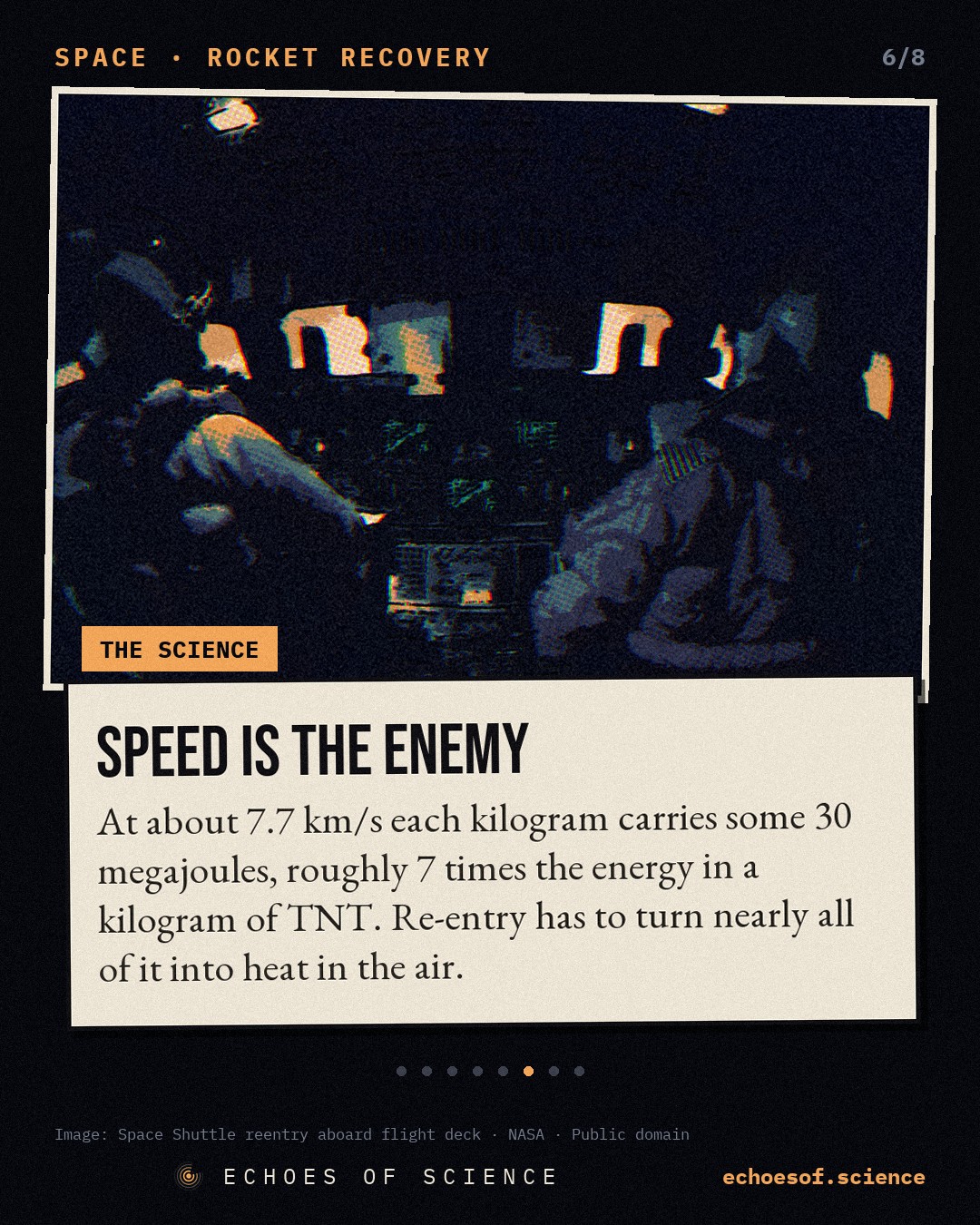
That speed is the whole problem. Half the speed squared gives the energy per kilogram: about 30 megajoules, roughly seven times what is released by a kilogram of TNT. A rocket cannot carry enough fuel to brake all of that away with its engines. Instead, re-entry hands the job to the air. The ship ploughs into the upper atmosphere, a shock wave forms in front of it, and the air there is squeezed and heated until it glows. A heat shield of ceramic tiles keeps that heat out of the steel hull while most of the energy is carried away by the air itself.
Lower down, the ship uses a second trick. Instead of falling nose-first, Starship falls belly-first, like a skydiver spreading their arms. That position gives the most drag and so the lowest terminal velocity, the steady speed reached when air resistance balances weight (NASA Glenn Research Center). Only near the end does it swing upright and fire its engines for a short landing burn, which saves propellant for the payload (Everyday Astronaut). The tower's arms then close around it.
How do we know? A catch with a long history
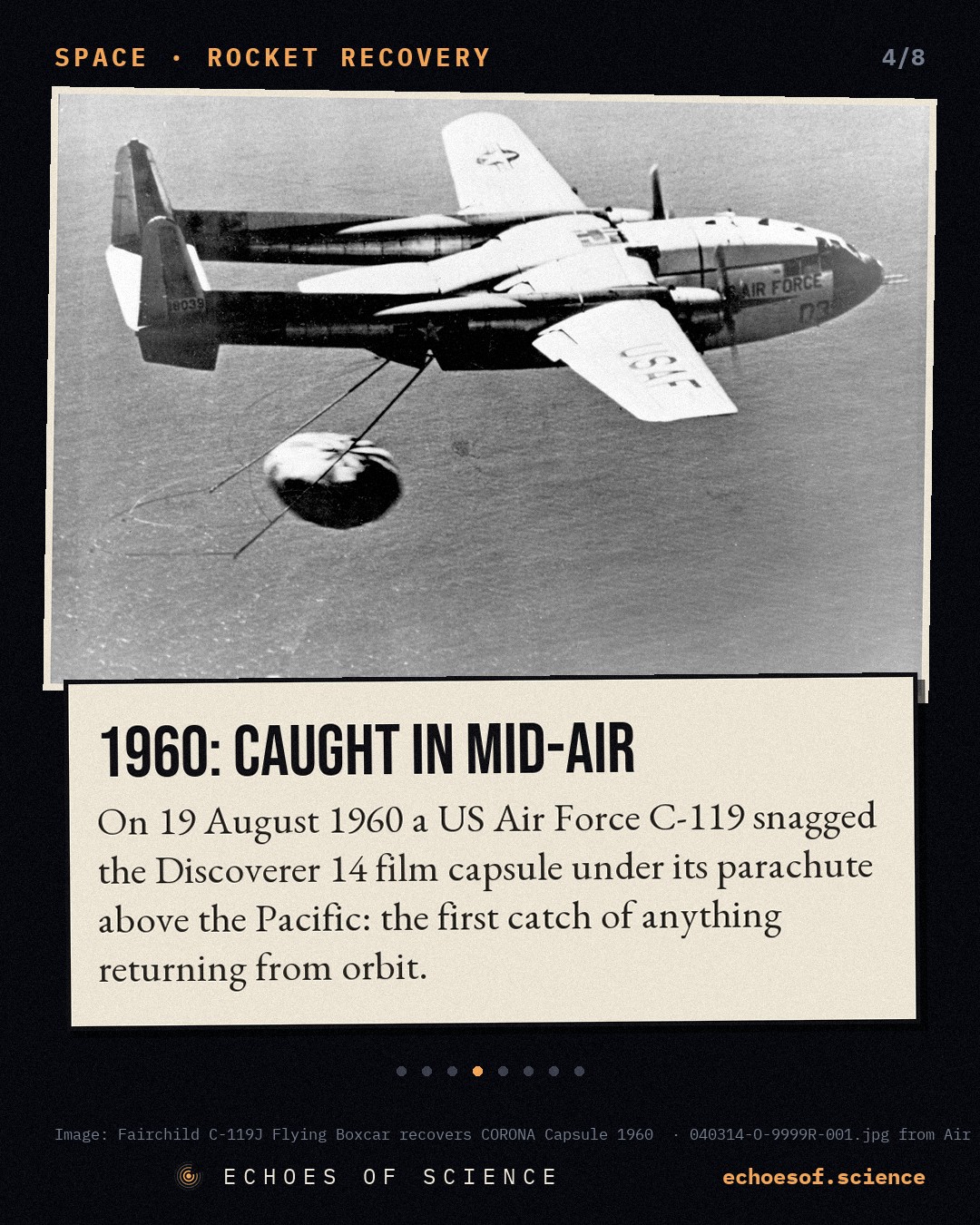
Catching things from orbit is older than most people think. On 19 August 1960 a US Air Force C-119 transport plane called "Pelican 9", flown by Captain Harold E. Mitchell, snagged a small capsule drifting under a parachute south-west of Honolulu (Discoverer 14). It held film from the secret Corona reconnaissance satellite, and it was the first object ever recovered after returning from orbit, caught at around 8,000 feet according to Vintage Aviation News.
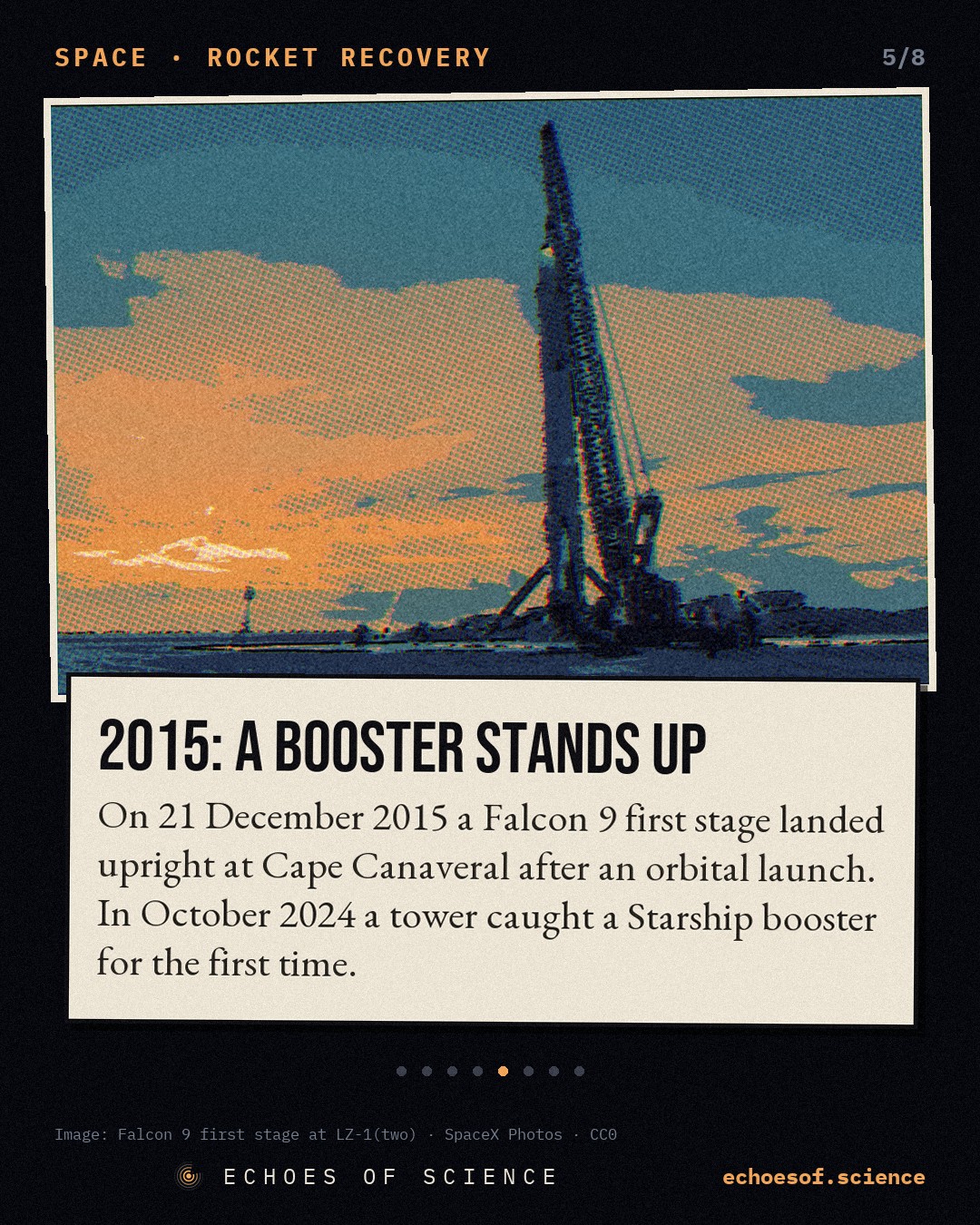
For decades after that, capsules came home under parachutes, the Space Shuttle glided back to a runway, and the rockets that launched them were largely thrown away. That changed on 21 December 2015, when a Falcon 9 first stage landed upright at Cape Canaveral after launching 11 satellites (Space.com). Boosters, though, never reach orbital speed. An upper stage has to survive the full fury of re-entry first, which is why Ship 42's catch matters.
Some things are still not done. No flight has yet recovered both stages, and a caught ship has not yet flown again. Those are the steps that would make a rocket truly reusable, like an aircraft.
Why it matters today
Almost every rocket ever launched has been thrown away after one flight. A stage that can be caught, inspected and refuelled changes the economics of getting to space, and the same physics applies to any vehicle returning from orbit, from capsules to future crewed landers. The hard part was never the catch itself. It was surviving the fall.
The science in this story
Key facts
- Starship Flight 15 launched from Starbase, Texas, at 22:47 GMT on 13 November 2026, with Super Heavy Booster 22 and Ship 42. source ↗
- Ship 42 deployed 26 Starlink V3 satellites, and three of them carried cameras to inspect its heat-shield tiles before the return. source ↗
- The tower's arms caught Ship 42 on 14 November 2026 at 21:20 GMT, about 22.5 hours after lift-off: the first Starship upper stage ever caught. source ↗
- The booster's planned catch was called off during descent; it splashed down in the Gulf of Mexico. Commentators linked this to a low-fuel alarm, and SpaceX was investigating. source ↗
- Super Heavy boosters had been caught by the tower on Flights 5 (13 October 2024), 7 (January 2025) and 8 (March 2025). source ↗
- On 19 August 1960 a US Air Force C-119, 'Pelican 9', caught the Discoverer 14 film capsule in mid-air south-west of Honolulu: the first aerial recovery of an object returning from orbit. source ↗
- A Falcon 9 first stage landed upright at Landing Zone 1, Cape Canaveral, after launching 11 Orbcomm satellites on 21 December 2015. source ↗
- A circular low Earth orbit needs about 7.9 km/s; orbiting is a continuous free fall that keeps missing the Earth. source ↗
- Starship falls belly-first to maximise drag and lower its terminal velocity before it flips upright for the landing burn. source ↗
In pictures
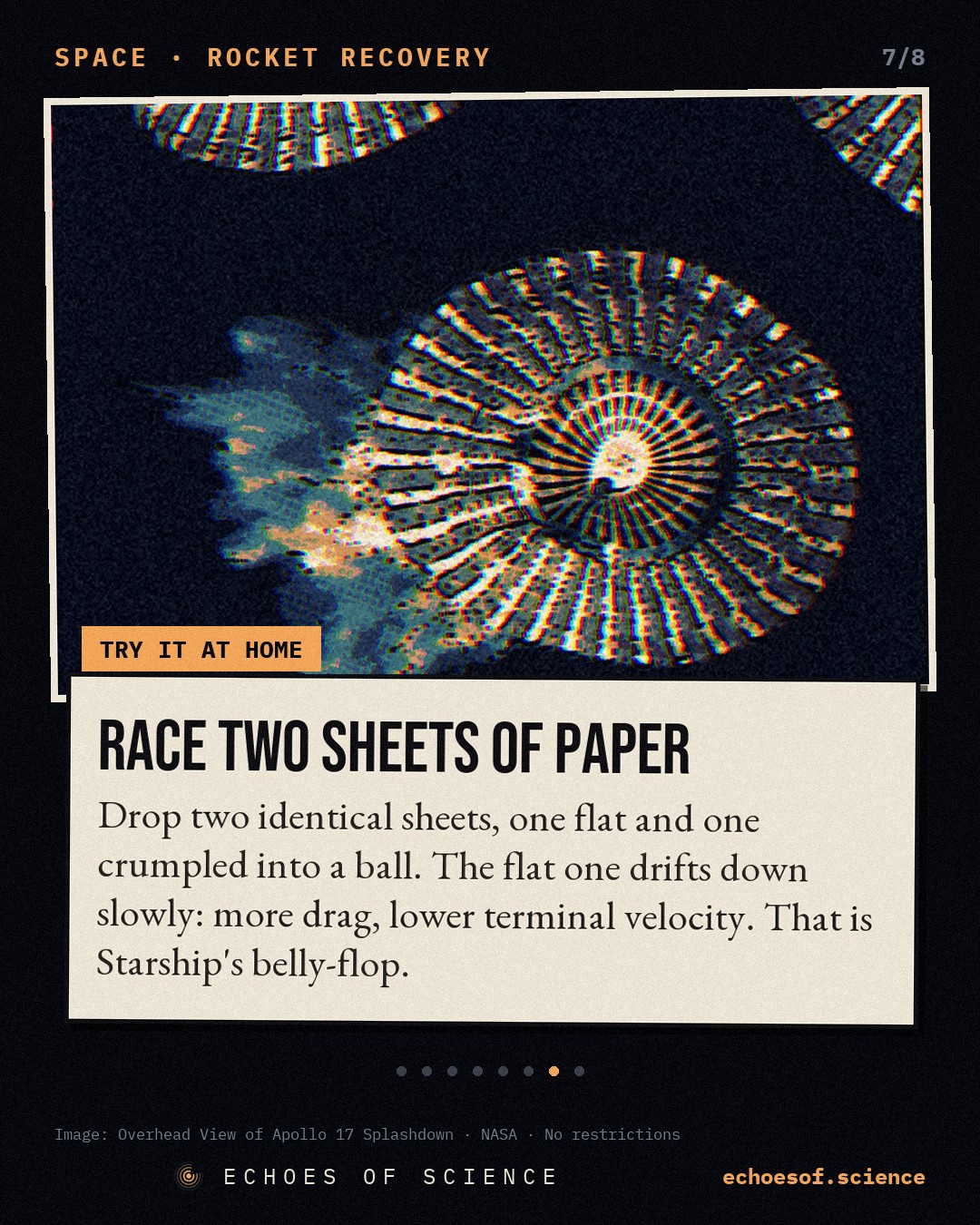

Drop two identical sheets of paper, one flat and one crumpled into a ball, from the same height. The flat sheet falls far more slowly: more drag, lower terminal velocity, just like Starship's belly-flop.
Loading the quiz…
Where every picture, clip and sound in this story comes from
Keep scrolling: more true stories ↓
New mini-documentaries every week and a true story every day. Pick where you like to watch:
▶ Subscribe on YouTube Telegram TikTok Instagram Bluesky Threads ✉ Weekly email
Everything here is free and stays free. If you would like to help us make more: 🪐 Shop: calendars, posters, mugs & books