Venus Was Born Earth's Twin. Did It Ever Have Oceans?
This is the surface of Venus: about 460 °C, with air pressing down 92 times harder than ours. Yet Venus was born almost a twin of the Earth, the same size and made of the same rock. Did it once have oceans and lose them, or was it never wet at all? Scientists are still arguing, and the answer may tell us how close the Earth came to the same fate.
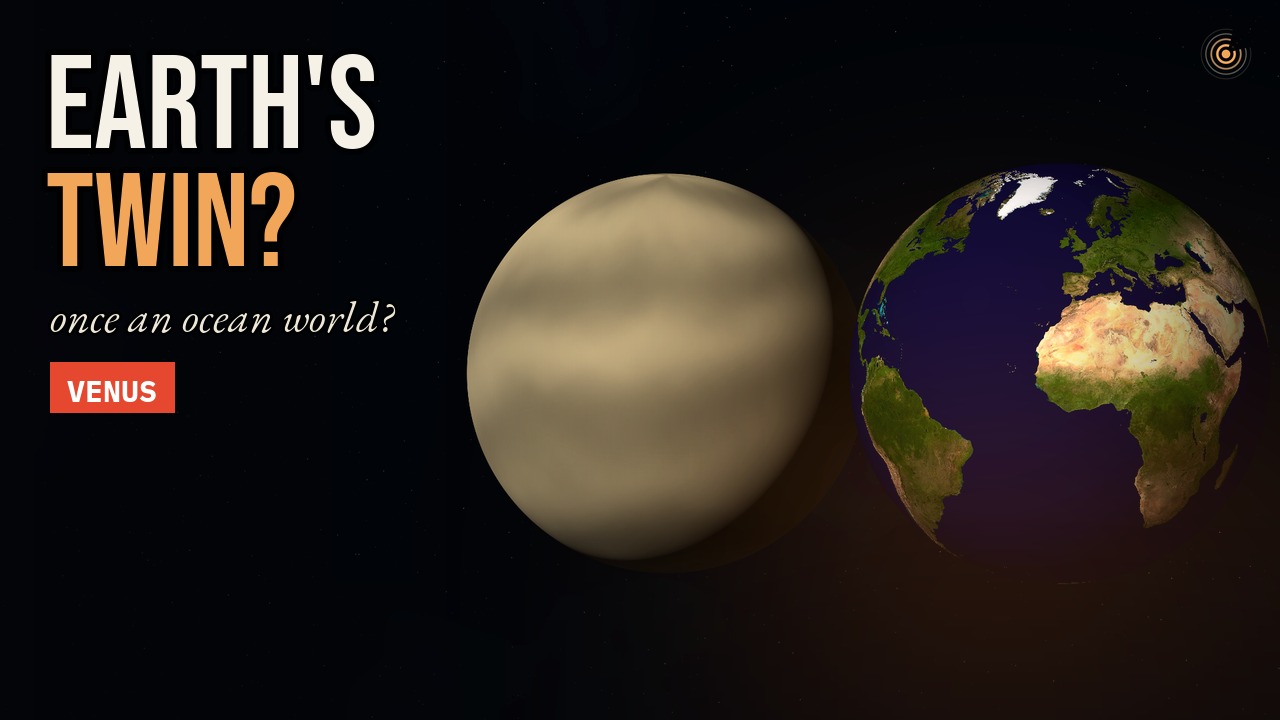 Premieres on YouTube Sunday 06 December, 17:00 UTC · subscribe to get it
This is the surface of Venus. It is hot enough to melt lead.
Day and night, the ground is about 460 °C. And the air presses down 92 times harder than on Earth.
And yet Venus was born almost a twin of our own planet: nearly the same size, made of the same kind of rock.
So what happened? Did Venus once have oceans like ours, and lose them? Or was it never wet at all? Scientists are still arguing.
Behind the Clouds
Venus is the brightest thing in the night sky after the Moon. But for centuries, no telescope could see its ground. It is wrapped in cloud from pole to pole.
In 1940, the astronomer Rupert Wildt made a rough calculation. Carbon dioxide had been found in the light of Venus, and carbon dioxide traps heat: the greenhouse effect. The surface, he argued, should be hotter than boiling water.
Then radio telescopes picked up the planet's own glow. In 1956, astronomers at the US Naval Research Laboratory measured microwaves coming from Venus. The readings pointed to something astonishing: more than 300 °C.
Not everyone believed it. Perhaps the radio glow came from high in the air, not from the ground. In 1960, a young doctoral student named Carl Sagan worked through the numbers. A thick atmosphere, he concluded, could turn Venus into a greenhouse furnace.
The question was settled in December 1962. NASA's Mariner 2 flew past Venus, the first spacecraft to explore another planet. Its instruments showed that the heat was coming from the surface itself.
Whatever lay under those clouds, it was not a gentle world. It was an oven. And to find out what kind of oven, someone would have to go down into it.
Landing in the Oven
The Soviet Union took on the challenge. In 1967, its probe Venera 4 fell into the atmosphere, and found air made mostly of carbon dioxide.
Three years later, on 15 December 1970, Venera 7 landed. For 23 minutes it sent back faint signals from the ground: a historic first, data from the surface of another planet.
In October 1975, Venera 9 sent back the first pictures from the surface. A plain of flat, broken slabs of rock. Its thermometer read 485 °C. It lasted 53 minutes.
Then, on 1 March 1982, Venera 13 landed and took the first colour pictures. Its instruments read 457 °C, and 89 atmospheres. It kept working for 2 hours and 7 minutes, still the record on Venus.
Landers and orbiters filled in the picture. Air that is 96.5% carbon dioxide. Clouds of sulphuric acid droplets. And near the ground, almost no water at all: about 20 parts per million.
Even the spin is strange. Venus turns backwards, the opposite way to most planets, and so slowly that one turn takes 243 Earth days. That is longer than its year, of 225 days.
Nobody is sure why it spins like that. But there is a bigger mystery. How did a world so like ours end up like this? And could it have happened to us?
Twins at Birth
Go back about 4.5 billion years. Around the young Sun, a disc of gas and dust is clumping into planets.
Two of them grow side by side. The inner one, at almost three-quarters of our distance from the Sun, becomes Venus. The other becomes the Earth.
They are built from the same neighbourhood of rocky material. Today Venus is 95% of the Earth's width, and about four-fifths of its mass.
Both are probably born hot. Giant collisions melt their surfaces into oceans of magma, and any water they hold is driven out into thick atmospheres of steam.
To make oceans, that steam has to cool and fall as rain. And here, distance matters. Today, Venus gets nearly twice as much sunlight as the Earth.
Back then the Sun was fainter, by up to 30%. But even that young Sun gave Venus about 40% more light than the Earth gets today.
So did the steam on Venus ever turn into rain? That is the question at the heart of this story. And the first real clue came from a probe that fell into Venus's air.
The Clue in the Hydrogen
In December 1978, NASA's Pioneer Venus mission dropped 4 probes into the atmosphere. The largest carried a mass spectrometer, an instrument that sorts molecules by their weight.
It measured something subtle. Hydrogen comes in two forms: ordinary hydrogen, and a heavier version called deuterium, with an extra neutron in its nucleus. They are isotopes of the same element.
In Earth's oceans, about 1 hydrogen atom in every 6,500 is deuterium. On Venus, the share turned out to be about 100 times higher.
In 1982, the team published their result in the journal Science, under a bold title: “Venus was wet”.
Here is the reasoning. High in the air, sunlight breaks water molecules apart. The light hydrogen escapes into space more easily than the heavier deuterium. Lose water like that for long enough, and the deuterium left behind piles up.
Venus has no magnetic field of its own. Its upper air meets the solar wind, the stream of particles from the Sun, head on. Over billions of years, its hydrogen has kept leaking away into space.
So Venus once had far more water than it has now. But the deuterium cannot say how much, or in what form. Was it an ocean? Or only steam, that never came down as rain?
In 2007, Europe's Venus Express caught the leak in the act. Out of the planet's night side, hydrogen and oxygen were streaming into space, about 2 hydrogen atoms for every oxygen. The same recipe as water.
Today, all the water in Venus's air would make a puddle about 3 cm deep, spread over the planet. Earth's oceans, spread out the same way, would be about 3 km deep.
An Ocean, or a Steam Bath?
In 2016, a team at NASA's Goddard Institute for Space Studies, led by Michael Way, ran a climate model of a young Venus with a shallow ocean.
In the model, Venus's slow spin made all the difference. Each patch of ground faces the Sun for almost two months at a time. That builds a thick deck of cloud on the day side, which reflects much of the sunlight back into space.
The result: Venus could have kept a shallow ocean, at temperatures a few degrees cooler than Earth's today, for up to 2 billion years.
In that picture, Venus was once a world with seas. And then something tipped it over.
What could have tipped a wet Venus over? In 2020, Way's team suggested huge volcanic outpourings, several at once, flooding the air with carbon dioxide faster than the planet could take it back.
That tipping point has a name: a runaway greenhouse. Warm the air, and more water evaporates. Water vapour traps heat, so the air warms further, and still more water evaporates, until the oceans boil away into the sky.
Its hydrogen leaks into space, and the water is gone for good. On Earth, rain, oceans and moving plates help lock carbon dioxide away in rock, such as limestone. On a dry Venus, it had nowhere to go but the sky.
But in 2021, a team led by Martin Turbet, at the University of Geneva, came to the opposite answer.
They simulated the steam atmospheres of the young Venus and the young Earth in three dimensions. On Venus, clouds formed mainly on the night side. There, they could not shade the ground from the Sun. Instead they held the heat in, like a blanket.
In their model, the steam on Venus never cooled enough to fall as rain. Oceans, they concluded, never formed.
And the same simulations held a surprise about us. In their model, the Earth came close to the same fate. What saved it, they argue, was the faint young Sun. Its weaker light let our steam cool, and rain out into the first oceans.
Then, in December 2024, a team at the University of Cambridge tried another approach. Not a climate model this time, but the chemistry of Venus's air today.
Sunlight and chemistry keep destroying some of the gases in Venus's air, so volcanoes must keep topping them up. Working backwards, the team estimated that those volcanic gases are at most 6% water. On Earth, volcanic gas is mostly steam.
A dry breath points to a dry interior. And a dry interior, they argue, means Venus probably never had oceans at all.
So the argument goes on. A long-lived ocean, says one model. Probably never any rain, say the other two studies. And the ground itself may be hiding the evidence.
A World Still Working
In August 1990, NASA's Magellan spacecraft reached Venus. It could not see through the clouds either, so it looked with radar.
Over 4 years, it mapped 98% of the surface. It found volcanoes everywhere. At least 85% of the ground is covered in lava flows.
Surprisingly few craters, too. Craters pile up over time, like footprints in fresh snow. The fewer there are, the younger the ground. Estimates for Venus range from about 150 to 800 million years. Something paved over most of the planet, long after it was born.
That matters for our question. Lava has buried most of what the first billions of years left behind. If Venus ever had shorelines, they may be hidden under it.
But Venus is not dead. In 2023, Robert Herrick and Scott Hensley went back to Magellan images from 1991. On a volcano called Maat Mons, a vent doubled in size in 8 months, and seemed to fill with lava.
It was the first direct geological evidence of recent volcanic activity on the surface of Venus. Some of its volcanoes may still be erupting today.
In 2021, NASA's Parker Solar Probe, swinging past on its way to the Sun, turned its camera on the night side of Venus. Through the clouds, it caught the ground itself, so hot that the rock gives off a faint glow of its own.
A volcanic world, still pouring gas into its sky. That gas may hold the answer. To read it, someone has to go back.
Japan's Akatsuki missed its first attempt to orbit Venus in 2010, and succeeded 5 years later. Until contact was lost in 2024, it watched the winds and clouds that any climate model of Venus has to get right.
Now new missions are being built. NASA's DAVINCI is to drop a probe through the atmosphere. During a fall of about an hour, it will taste the air, including the noble gases and the deuterium that record the history of Venus's water.
It is currently planned to launch at the end of 2030 (as of October 2026).
NASA's VERITAS and Europe's EnVision are orbiters, planned for the early 2030s. They will map the surface with new radar, watch for active volcanoes, and study the oldest rocks, the high plateaus called tesserae.
If those old rocks turn out to be like Earth's continents, which seem to need water to form, the ocean idea gets much stronger. If not, the case for a Venus that was always dry grows.
And DAVINCI's noble gases will help too. They barely react with anything, so they keep a record of where the planet's air came from, and how much of it has been lost.
Epilogue
So, how was Venus born? Almost the same as the Earth. On that, everyone agrees.
What happened next is still open. Either Venus had seas, and lost them. Or the steam never fell as rain at all.
Either way, it is a reminder. Two planets made of the same stuff can end up as different as a garden and an oven. And the difference may have come down to a little distance from the Sun, and a little luck.
Venus now takes its place on our map. Next week: Mars. A planet that grew fast, and then stopped.
On our website, try it yourself: keep a young planet's ocean from boiling away, while its sun grows brighter.
The science in this story
Key facts
- Venus has 0.95 of Earth's radius and 0.815 of its mass; its surface is 464 °C at 92 bar under air that is 96.5% CO2, and it spins backwards once every 243 days. source ↗
- Venera 13 landed on 1 March 1982, took the first colour pictures of Venus's surface and survived 127 minutes at 457 °C and 89 atmospheres. source ↗
- Pioneer Venus measured a deuterium-to-hydrogen ratio about 100 times Earth's ('Venus Was Wet', Science, 1982). source ↗
- A 2016 NASA GISS model found Venus could have kept a shallow ocean for up to 2 billion years; Turbet et al. (Nature, 2021) and Constantinou et al. (Nature Astronomy, 2024) argue it never had oceans. source ↗
Loading the quiz…
Sources
- NASA NSSDC Venus fact sheet · NASA Science: Venus facts · AIP History of Climate: Venus (Wildt 1940, Mayer et al. 1956/58, Sagan 1960) · NASA: Mariner 2 at 60
- NSSDC Venera mission summaries · Donahue et al., Science 1982 ('Venus Was Wet') · ESA Venus Express: Barabash et al., Nature 2007; 'Was Venus once a habitable planet?' (2010)
- Way et al., GRL 2016 · Way & Del Genio, JGR Planets 2020 · Turbet et al., Nature 2021 · Constantinou, Shorttle & Rimmer, Nature Astronomy 2024
- NSSDC/NASA Magellan · Herrick & Hensley, Science 2023 · Wood et al., GRL 2022 (Parker Solar Probe WISPR) · NASA DAVINCI, VERITAS · ESA EnVision · JAXA Akatsuki
Where every picture, clip and sound in this story comes from
Keep scrolling: more true stories ↓
New mini-documentaries every week and a true story every day. Pick where you like to watch:
▶ Subscribe on YouTube Telegram TikTok Instagram Bluesky Threads ✉ Weekly email
Everything here is free and stays free. If you would like to help us make more: 🪐 Shop: calendars, posters, mugs & books